Choosing the right Micro Water Pump begins with understanding the real operating conditions, not just the pump’s size. A compact pump may look suitable on a product page, yet struggle when the tubing is narrow or the outlet sits higher than expected. Flow rate, pressure head, voltage, current, and fluid temperature must work together. A pump rated at 1.5 liters per minute may deliver far less through a long tube with several bends. Small details matter.
Start with the application. Will the pump run continuously, intermittently, or only for a few seconds? Check whether the fluid is clean water, a mildly warm liquid, or something chemically aggressive. Confirm the wetted materials before purchase. Diaphragm, centrifugal, and peristaltic designs behave differently, especially during priming and dry running. Noise also matters in laboratory equipment, portable appliances, and indoor projects. I once chose a pump by flow rate alone. It met the number, but overheated during extended operation. That mistake was avoidable.
Reliable selection depends on datasheets, measured performance, and honest testing. Compare the pump curve with your system’s required flow and head. Verify power compatibility, connector type, sealing, and control requirements. Leave a practical safety margin, but do not oversize without reason. Excess pressure can waste energy and stress fittings. This guide explains how to evaluate these factors clearly, from basic specifications to installation checks. Some applications still need testing under real conditions. No catalog replaces that step.
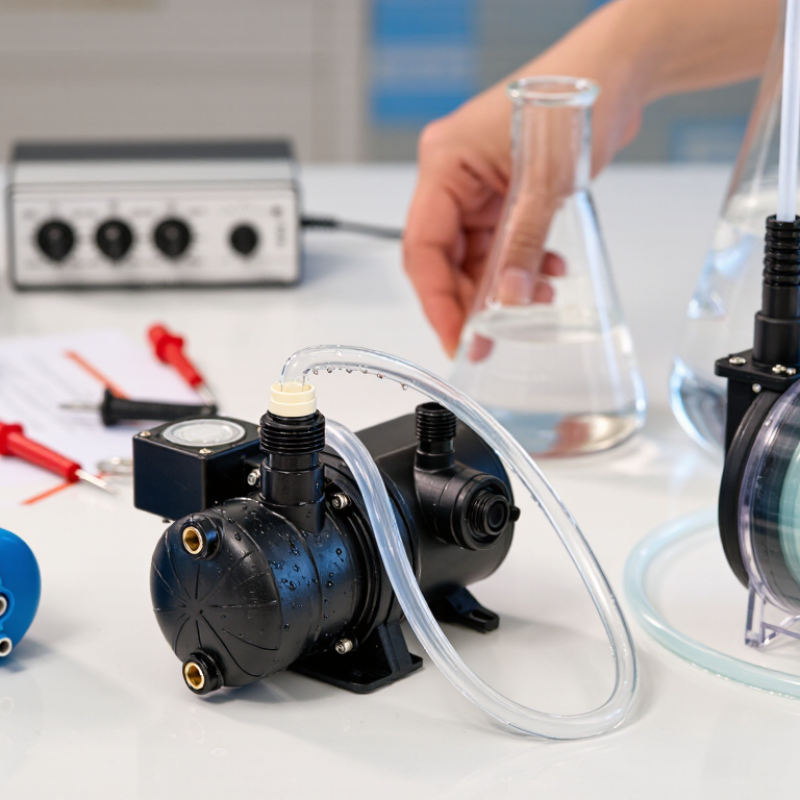
What Is a Micro Water Pump and How Does It Work?
A micro water pump is a compact device that moves small amounts of water through narrow tubing. It usually combines a small electric motor with an impeller, diaphragm, or peristaltic mechanism. When power reaches the motor, the moving parts create pressure differences. Water enters through the inlet and leaves through the outlet. Simple in principle, but performance changes quickly with tube length, height, and resistance.
In practical testing, a pump can appear powerful on the bench yet struggle inside a machine. The advertised flow rate often assumes open discharge and minimal lifting. Real systems need more pressure. Check the required flow, lift height, voltage, current, and outlet size before choosing. A pump rated for continuous use is safer for long operating periods. Some models cannot tolerate dry running, while others manage short periods without water. Read the technical sheet carefully.
I once focused too much on flow rate. That was a mistake. The pump moved water quickly, but its pressure was insufficient for the installation. Noise, heat, and vibration also matter in compact equipment. Diaphragm pumps suit controlled dosing, while centrifugal pumps often provide smoother flow. Peristaltic designs can reduce fluid contact with internal parts. However, tubing eventually wears. Confirm material compatibility with the water, temperature range, cleaning method, and expected service life. A reliable choice matches the whole system, not just one impressive number.
How to Match Pump Flow Rate and Pressure to Your Application
Choosing the right micro water pump begins with the duty point, not the pump’s maximum rating. Define the required flow rate in litres per minute, then calculate total pressure. This includes vertical lift, tubing friction, filters, valves, and the outlet pressure. One bar equals approximately 10.2 metres of water head. For a small dispenser, 1.5 L/min at 0.8 bar may work. A spray nozzle could need less flow but higher pressure. Check the pump curve at the actual operating point. Never select only by free-flow capacity.
Efficiency matters, even in compact equipment. The U.S. Department of Energy’s Improving Pumping System Performance sourcebook reports that optimized pumping systems can often reduce energy use by 20–50 percent. The IEA’s Energy Efficiency 2022 report also identifies motor systems as responsible for more than half of global electricity consumption. Small pumps still deserve careful sizing. Measure the real hose length and count every sharp bend. Bubbles matter. Warm liquids can change performance. The calculation is rarely perfect. I would leave a modest pressure margin, but excessive capacity may cause noise, heat, and unnecessary power demand. A pump operating near shutoff can fail sooner. A pump running continuously at its limit can also disappoint. Recheck the pressure and flow after installation. Field conditions often expose assumptions that looked correct on paper.
How to Choose the Right Micro Water Pump? - How to Match Pump Flow Rate and Pressure to Your Application
| Application |
Required Flow
(L/min) |
Required Pressure
(kPa / bar) |
Equivalent Head
(m of water) |
Suggested Pump Class |
Recommended Design Margin |
Key Selection Consideration |
| Microfluidic cooling loop |
0.10–0.50 |
100–200 / 1.0–2.0 |
10–20 |
Brushless centrifugal or diaphragm |
20–30% |
Check heat generation, continuous-duty rating, tubing diameter, and chemical compatibility with the coolant. |
| Condensate or drainage system |
0.50–2.00 |
30–100 / 0.3–1.0 |
3–10 |
Compact centrifugal |
15–25% |
Prioritize self-priming capability, low inlet height, intermittent operation, and resistance to suspended particles. |
| Portable water dispenser |
0.30–1.00 |
80–150 / 0.8–1.5 |
8–15 |
Diaphragm or peristaltic |
20% |
Use food-contact-compatible wetted materials where required and verify noise, pulsation, and dry-run limits. |
| Laboratory sampling system |
0.05–0.30 |
50–150 / 0.5–1.5 |
5–15 |
Peristaltic or precision diaphragm |
10–20% |
Select low-pulsation control, accurate metering, cleanability, and tubing or membrane compatibility. |
| Small spray or misting system |
0.20–1.00 |
200–500 / 2.0–5.0 |
20–51 |
High-pressure diaphragm |
25–35% |
Match the pump to nozzle pressure, include a filter, and confirm that seals tolerate the liquid and operating temperature. |
| Compact irrigation or hydroponics loop |
1.00–5.00 |
50–250 / 0.5–2.5 |
5–25 |
Centrifugal or brushless circulation pump |
20–30% |
Calculate friction losses through emitters and filters, and select a pump rated for the required continuous operating time. |
| Portable cleaning or wash-down tool |
0.50–2.00 |
300–700 / 3.0–7.0 |
31–71 |
High-pressure diaphragm or piston |
25–40% |
Verify maximum pressure, duty cycle, thermal protection, vibration control, and compatibility with detergents. |
Quick sizing rules
- Choose the pump at the intersection of the required flow rate and total system pressure, rather than using the pump's free-flow value alone.
- Total pressure includes static lift, tubing and fitting losses, filters, valves, nozzles, and the pressure required by the end device.
- For water, approximately 100 kPa = 1 bar = 10.2 m of water head at standard conditions.
- Allow a practical design margin, but avoid excessive oversizing because it can increase noise, power consumption, heat, and flow-control difficulty.
- Confirm voltage, current, inlet conditions, priming behavior, wetted-material compatibility, duty cycle, and dry-run capability before final selection.
Which Pump Type, Power Source, and Materials Should You Choose?
How to Choose the Right Micro Water Pump?
Which Pump Type, Power Source, and Materials Should You Choose?
Pump type should match the fluid, pressure, and operating rhythm. Diaphragm pumps suit intermittent dosing and can handle slight contamination. Peristaltic pumps keep the fluid inside flexible tubing, reducing cross-contamination risks. Centrifugal micro pumps work better with clean fluids and steady flow. Small is not simple. A pump rated for 1 liter per minute may deliver far less against narrow tubing or a raised outlet.
Power selection deserves equal attention. The IEA’s Energy Efficiency 2023 report estimates that electric motor systems consume about 53% of global electricity. A tiny pump still wastes energy when oversized. Match the voltage to the available supply, then check starting current, continuous duty, and battery capacity. DC pumps fit portable equipment, while regulated adapters suit fixed installations. Measure actual flow under load. Catalog numbers can be optimistic.
Material compatibility is often the overlooked failure point. Polypropylene handles many mild aqueous solutions, while PVDF offers stronger chemical resistance. PTFE is useful for demanding fluid paths, but it can increase cost and reduce flexibility. Silicone tubing remains flexible, yet temperature and pressure limits must be verified. Stainless steel tolerates heat and mechanical wear, but not every chemical environment. Check wetted materials against the fluid’s pH, temperature, and additives. ISO 9906 emphasizes performance testing, but real systems include bends, valves, and air bubbles. A perfect datasheet still misses those details. Test a working prototype before committing to volume.
How to Choose the Right Micro Water Pump?
Which pump type, power source, and materials should you choose?
How to Read the Chart
The chart compares representative maximum flow rates commonly found in compact water-pump applications. Actual performance depends on voltage, pressure, tubing size, head height, temperature, and operating duty cycle.
- Diaphragm pumps: Suitable for pressurized water delivery, dosing, spraying, and applications requiring self-priming.
- Centrifugal pumps: A practical choice for continuous circulation and higher flow at low to moderate pressure.
- Piston pumps: Preferred when higher pressure and accurate liquid delivery are more important than flow rate.
- Peristaltic pumps: Useful for clean or sensitive fluids because the liquid contacts only the tubing.
- Power source: Select DC for battery-powered or portable equipment, and AC for continuous stationary operation. Match the pump voltage to the available power supply.
- Materials: Use polypropylene or nylon for general water service, stainless steel for improved corrosion resistance, and silicone, EPDM, or PTFE wetted parts when chemical compatibility or temperature resistance is required.
How to Check Size, Noise, Durability, and Operating Conditions
How to Choose the Right Micro Water Pump?
Choosing a micro water pump starts with its physical size and installation space. Measure the available length, width, and height before comparing specifications. Leave room for tubing, connectors, and maintenance access. A pump that fits on paper may still be difficult to service. Check the inlet and outlet diameter carefully. A mismatched tube can restrict flow and increase pressure. I once selected a compact pump without checking cable clearance. The installation worked, but repairs became unnecessarily awkward.
Noise deserves practical testing, not just a catalog rating. Place the pump on its intended surface and listen during startup and continuous operation. Vibration often travels through rigid panels, making a quiet motor sound louder. Rubber mounts can reduce this effect. Also check the required flow rate, because an undersized pump may run continuously and create more noise. Silence matters in medical equipment, laboratory instruments, and indoor cooling systems.
Durability depends on more than operating hours. Confirm the pump’s duty cycle, fluid compatibility, temperature range, and resistance to dust or moisture. Some pumps tolerate intermittent use but overheat during continuous operation. Others require clean water and fail quickly with particles. Operating altitude may also affect cooling and performance. Read the technical data, then test the pump under real load. This step is easy to skip. It should not be. Keep a small margin between the pump’s maximum rating and your normal operating condition.
What Installation and Maintenance Factors Affect Pump Performance?
Choosing a micro water pump is not only a flow-rate decision. Installation details often determine real performance. The U.S. Department of Energy reports that pumping systems can consume 25–50% of electricity in some industrial facilities. Even a small pump deserves careful setup. Keep the inlet tube short, straight, and wide enough to reduce suction losses. A loose connection may draw air without showing visible leakage. That small fault can cause unstable flow.
Mount the pump on a firm surface. Excessive vibration can loosen fittings and shorten bearing life. Check the operating voltage at the pump terminals, not only at the power supply. Long, thin wires can create voltage drop. Heat also matters. The manufacturer’s rated flow usually assumes a specific head, voltage, and temperature. In practice, performance may fall sharply when these conditions change. I have found that a quieter installation is not always a more efficient one.
Maintenance should follow operating conditions, not a convenient calendar. Inspect filters, tubing, and seals for deposits, swelling, or cracks. Never assume clean water means clean channels. Fine particles can restrict a narrow passage. The U.S. Department of Energy’s Operations and Maintenance Best Practices report associates effective preventive maintenance with energy savings of roughly 5–20%. Record flow, noise, current, and outlet pressure during normal operation. A baseline makes gradual decline visible. Recheck it after cleaning, because a partially blocked filter can hide a developing pump problem.
FAQS
Define the required flow rate and total pressure at the actual duty point. Do not rely on maximum free-flow capacity. Include vertical lift, tubing friction, filters, valves, and outlet pressure. A small dispenser might need 1.5 L/min at 0.8 bar. The real setup may differ.
Add every pressure loss in the system. Measure vertical height and hose length. Count sharp bends. One bar equals approximately 10.2 metres of water head. A long, narrow tube can reduce flow noticeably. My calculation might still be imperfect.
Not automatically. Excess capacity can create noise, heat, and unnecessary power demand. A pump near shutoff may wear sooner. Continuous operation at its limit can also disappoint. A modest pressure margin is usually more sensible. Bigger is not always safer.
Find the curve point matching your required flow and pressure. Check performance with actual tubing, filters, valves, and outlet conditions. Free-flow data alone is insufficient. Recheck flow and pressure after installation. Paper calculations can hide real losses.
Measure available length, width, and height first. Leave clearance for tubing, connectors, cables, and maintenance. Confirm inlet and outlet diameters. A mismatched tube can restrict flow and raise pressure. Space for repairs matters.
Test the pump on its intended surface during startup and continuous operation. Rigid panels can transmit vibration across an enclosure. Rubber mounts may reduce this effect. An undersized pump may run continuously and sound louder. Test it in place.
Check duty cycle, fluid compatibility, temperature range, and dust or moisture resistance. Some pumps tolerate intermittent use but overheat during continuous operation. Particles can quickly damage pumps designed for clean water. Warm liquid may change performance. Real-load testing is essential.
Small equipment still consumes energy, especially during continuous operation. Correct sizing can reduce wasted power and excess heat. Motor systems represent a large share of electricity use worldwide. Efficiency deserves attention, even in compact equipment. I might overlook it. Don't.
Conclusion
Choosing the right Micro Water Pump starts with understanding how it moves liquid and what your application requires. Evaluate the desired flow rate, pressure, lift height, and duty cycle to ensure the pump can perform reliably without excessive strain. You should also compare pump types, power sources, and construction materials according to the liquid being handled, available electricity, temperature, and chemical conditions. A proper match improves efficiency, stability, and service life.
Before purchasing, check the pump’s dimensions, connection sizes, noise level, and expected durability, especially if it will be installed in a compact or sensitive environment. Operating conditions such as dry running, continuous use, ambient temperature, and potential debris can strongly affect performance. Correct installation, secure tubing, suitable filters, and regular inspection are equally important. Cleaning the system, checking seals and connections, and following safe operating practices will help maintain consistent output and prevent avoidable failures.

 ANHAN TRADE